TPO 80-Mil Roofing Systems in Fort Collins, CO
Commercial Roofing
Roof Systems
When 80-Mil TPO Is the Right Call, Not Simply the Upsell
We get asked about 80-mil TPO almost every time a building has an open insurance claim from hail. It's the thickest single-ply TPO sheet most manufacturers roll off the line, and it's not cheap. On the right building, it's worth every dollar. On the wrong one, it's overkill that doesn't change the risk picture much.
The Hail Math Behind 80-Mil
Weld and Larimer counties see hailstones that go well past pea and dime size in a bad storm year. Under UL 2218 and FM 4473 impact testing, thicker membrane generally performs better against larger stone sizes, and 80-mil sheet holds up to impacts that would puncture 45-mil or even bruise 60-mil sheet. For a building with a documented hail claims history, or an insurer requiring a higher impact class as a condition of coverage, 80-mil often becomes the practical answer rather than a luxury option.
We've torn off 60-mil roofs on grain and ag-processing buildings out toward Ault and Pierce that took direct hits from stones bigger than what most product testing accounts for. On those rebuilds, 80-mil made sense given what the building had already been through.
Weight, Fastening, and Rooftop Equipment
Eighty-mil sheet is heavier and stiffer to handle on the roof, which changes crew pace and detailing at penetrations. We run a slower, more deliberate flashing sequence around curbs and rooftop units on these jobs because the membrane doesn't drape the same way thinner sheet does. Rooftop units on manufacturing and light industrial buildings around Fort Collins tend to be dense — HVAC, exhaust, dust collection — and every one of those penetrations is a place the membrane has to be worked by hand, not simply rolled out flat.
Altitude UV and Long-Term Membrane Wear
At roughly 5,000 feet, UV load on a roof surface is higher than most manufacturer test data assumes, since a lot of that testing happens near sea level. Thicker membrane simply has more material to sacrifice to UV breakdown before the reinforcing scrim shows. On unshaded south-facing roof planes — common on single-story retail pads out along the Timnath and Johnstown growth corridor — that extra material matters more than it would on a shaded, parapet-heavy downtown building.
Wind and the Front Range Downslope Pattern
Wind uplift resistance improves with membrane thickness in most fastening configurations, which matters on taller buildings and anything exposed to the downslope wind that comes off the foothills through the Poudre corridor. We still calculate fastening pattern and plate spacing to the building's actual exposure category rather than assuming thickness alone solves uplift. An 80-mil membrane fastened too sparsely can still lift in a bad gust event.
Freeze-Thaw Behavior of Heavier Sheet
Heavier membrane resists the daily freeze-thaw cycling common here better than thin sheet, particularly at seams and flashing terminations where repeated expansion and contraction eventually fatigues the weld. We've reworked seams on thinner membrane roofs that cracked after a handful of Front Range winters. Eighty-mil doesn't eliminate that stress, but it gives the seam more mass to absorb it.
Where 80-Mil Actually Makes Sense
We don't spec 80-mil as a default. It's the right call on a specific set of buildings:
- Buildings with an active or recent hail insurance claim and an adjuster asking about impact class
- Ag processing and grain facilities in the eastern part of our service area exposed to open-country hail
- Manufacturing plants with dense rooftop equipment and heavy maintenance foot traffic
- Buildings where the owner is self-insured or carries a high deductible and wants to reduce repair frequency
- Long-hold institutional buildings where a 30-year roof life is the actual goal
For a strip retail building the owner plans to sell in a few years, or a low-slope roof shielded by taller neighboring structures, 60-mil usually gets the same practical result for less money.
Installation Quality Still Decides the Outcome
An 80-mil roof with a bad seam weld or shortcut flashing detail will still leak. Thickness protects against impact and UV degradation — it doesn't fix a crew that rushes penetration work. We probe every welded seam on these jobs and walk the drains and scuppers before we call a job complete, the same as we do on any membrane thickness.
What Clients Ask Before Approving 80-Mil
Is 80-mil TPO required by my insurance company?
Some insurers set impact class requirements as a condition of coverage after a claim, but that's a policy-specific question your agent or adjuster can answer directly. We can tell you what impact class a given membrane thickness typically achieves.
How much heavier is 80-mil to work with on the roof?
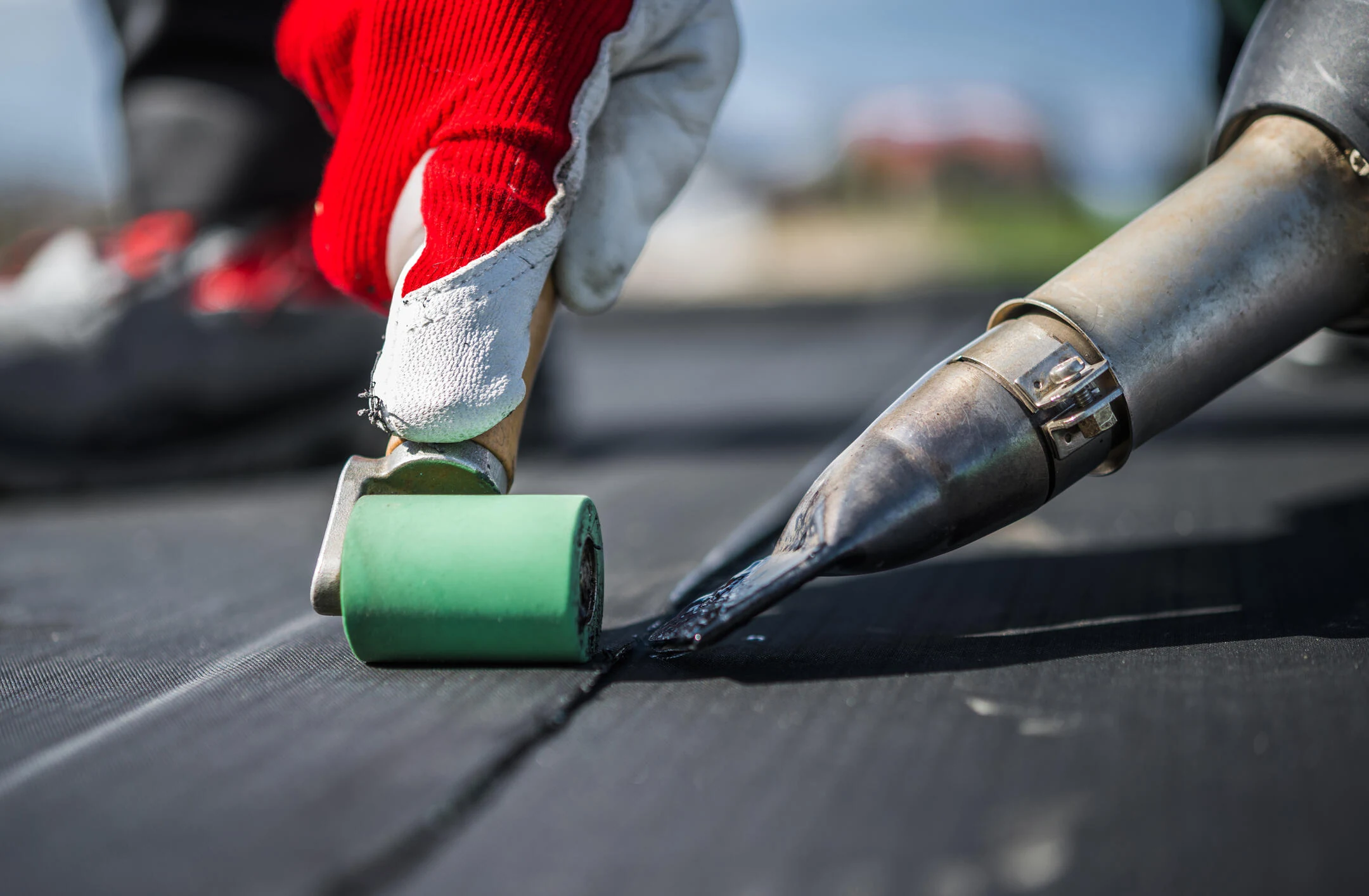
Noticeably. Rolls are heavier, seams take more heat and dwell time to weld properly, and flashing detail work moves slower than it would on 45 or 60-mil.
Does 80-mil TPO need different insulation underneath?
Not necessarily. Insulation selection is driven more by the deck type, code requirements, and thermal performance goals than by membrane thickness.
Will 80-mil lower my insurance premium?
That's a conversation for your insurance agent. We can provide documentation on the membrane and impact class installed, but we don't make premium promises.
Can 80-mil be installed as a recover over an existing roof?
Sometimes, depending on deck condition and existing insulation. We check that during inspection rather than assuming it either way.
Roof
GALLERY