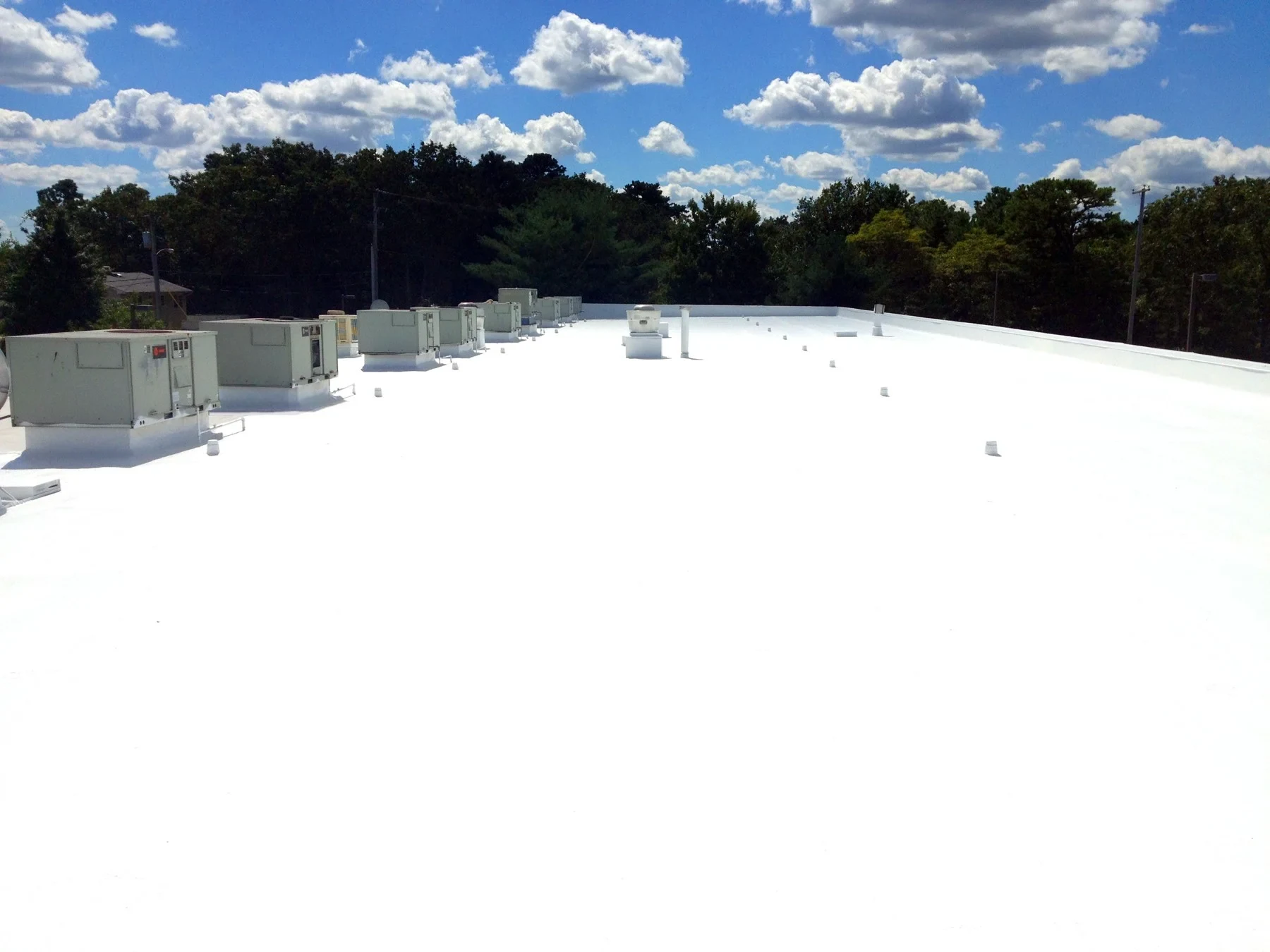
PVC Roofing in Fort Collins, CO
Commercial Roofing
Commercial Roofing Services
PVC Membranes for Brewery and Food Plant Roof Decks
PVC is the membrane we reach for when grease, hop oils, or kitchen exhaust sit on a roof deck day after day. Fort Collins has a lot of that kind of building, and PVC handles chemical exposure that shortens the life of other single-ply membranes.
Why Grease and Exhaust Wear Out Ordinary Membranes Fast
Large brewing operations in this town run rooftop exhaust systems that vent brewing byproducts, cleaning chemicals, and steam around the clock. Restaurant and brewpub roofs along College Avenue and in Old Town deal with the same problem on a smaller scale, with kitchen exhaust fans depositing grease near roof penetrations and equipment curbs.
Standard TPO and EPDM sheets can soften, swell, or lose adhesion where oils and solvents pool near an exhaust outlet. We've pulled membrane samples off brewery roofs that were still structurally sound in the open field but degraded within a few feet of a vent stack. That's the exact failure pattern PVC is formulated to resist.
Hot-Air Welded Seams That Hold Up Under Chemical Load
PVC seams are heat-welded like TPO, but the polymer itself carries plasticizers and a chemical formulation that resists fats, oils, and many industrial solvents better than a thermoplastic olefin sheet. On a brewery roof with exhaust stacks scattered across the field, that resistance matters more than raw membrane thickness.
We still run the same probe testing on PVC seams that we run on every welded membrane. A brewery roof gets walked constantly for maintenance on rooftop units and exhaust equipment, and a weak seam under that kind of traffic fails faster than one on a roof nobody touches.
What We Check Before We Spec a PVC Roof
PVC costs more than TPO per square, so we don't default to it. Before recommending it, we look at:
- Number and type of rooftop exhaust outlets, and whether grease or chemical residue is already visible on the existing roof
- Distance between exhaust equipment and the nearest roof drain or scupper
- Existing membrane condition near vent stacks compared to the open field
- Building use classification, since restaurant and food processing tenants change the exposure math
- Local fire code requirements for kitchen exhaust roof penetrations
- Budget tolerance for the premium over TPO given the exposure risk
PVC Thickness and Hail Exposure on the Front Range
Chemical resistance doesn't replace hail resistance, and this market sees both. We spec 60-mil PVC as the practical floor on any brewery or food plant roof, moving to 80-mil on buildings with a documented hail claim history or high replacement cost. A thin PVC sheet handles grease fine but still bruises and tears under golf-ball hail the same as a thin TPO sheet would.
Owners sometimes ask why they'd pay for both chemical resistance and thicker membrane. The honest answer is that a brewery roof in this market faces both risks at once, and skimping on either one just moves the failure point somewhere else on the roof.
When We Steer Owners Toward TPO or EPDM Instead
Not every commercial roof needs PVC. An office building or a school with no kitchen exhaust or industrial process venting doesn't gain much from the chemical resistance, and the cost premium isn't worth it. We reserve PVC recommendations for roofs with a real exposure source: brewing, food processing, restaurant exhaust, or occasionally light industrial operations with solvent use.
We'd rather tell an owner they don't need PVC than sell it where TPO would perform just as well for less money. That call comes down to walking the roof and looking at what's actually venting onto it, not a blanket recommendation.
Detailing Around Exhaust Fans and Grease Interceptors
Even on a PVC roof, detail work around exhaust equipment matters as much as membrane selection. We build up flashing height and add extra membrane reinforcement around exhaust fan curbs where grease residue concentrates, since that's the spot most likely to see accelerated wear regardless of which membrane chemistry sits underneath it.
Rooftop grease interceptor pans, where a building has them, need periodic cleaning that's separate from general roof maintenance. We coordinate with kitchen and facilities staff on that schedule so buildup doesn't sit directly on the membrane surface between cleanings, since standing grease works against even PVC's chemical resistance if it's left in contact with the roof for months at a time.
What Building Owners Ask About PVC Roofing
Does PVC cost a lot more than TPO?
Yes, typically a meaningful premium per square. We only recommend it where chemical or grease exposure justifies that cost.
Can PVC go over an existing brewery roof without tearing it off?
Sometimes, if the deck is dry and the existing membrane is stable enough to serve as a substrate. We check moisture and code layer limits before quoting a recover.
How long does a PVC roof typically last on a brewery building?
It depends heavily on maintenance and exhaust exposure, but a well-installed PVC system generally outlasts TPO in the same chemical environment. We don't promise a specific number of years since exposure varies so much building to building.
Will PVC handle Front Range hail as well as TPO?
At matched thickness, performance is similar. The chemical resistance is PVC's advantage, not extra hail toughness, so thickness selection still drives hail performance.
Do restaurant roofs in Old Town need PVC even with small exhaust fans?
Not always. A single small kitchen exhaust fan on a compact roof may not justify the cost. We look at exhaust volume and roof age before making that call.
Roof
GALLERY