Roof Drains & Scuppers in Fort Collins, CO
Commercial Roofing
Commercial Roofing Services
Roof Drains and Scuppers for Fort Collins Flat and Low-Slope Roofs
A flat commercial roof only works if the water on it has somewhere to go, fast. Drains and scuppers do that job, and on Front Range roofs they take on a specific set of problems — hail granules and debris that clog strainers, freeze-thaw cycling that works joints loose, and seasonal debris load from cottonwoods and other trees common around Fort Collins. We service, repair, and reconfigure roof drainage for commercial buildings throughout the area.
Internal Drains: Clearing, Sump Repair, and Clamping Ring Issues
Internal drains sit at the low point of the roof deck and carry water down through the building rather than off the edge. They fail in a few predictable ways. The strainer basket clogs with granules, leaves, or hail debris and water backs up around it. The clamping ring that holds the membrane sealed to the drain bowl loosens or was never properly seated, and water tracks underneath the membrane instead of into the drain. The sump itself — the slightly recessed area around the drain — can lose its slope over time as the roof deck settles or as recover layers get added without re-establishing proper pitch to the drain.
We check all three on a drain inspection: strainer condition and clearance, clamping ring tightness and seal integrity, and sump slope. A drain that looks fine from a glance at the strainer can still be leaking underneath if the clamping ring isn't seated right, which is why we pull strainers and check the seal directly rather than assuming a clear strainer means a working drain.
Scuppers on Parapet Roofs
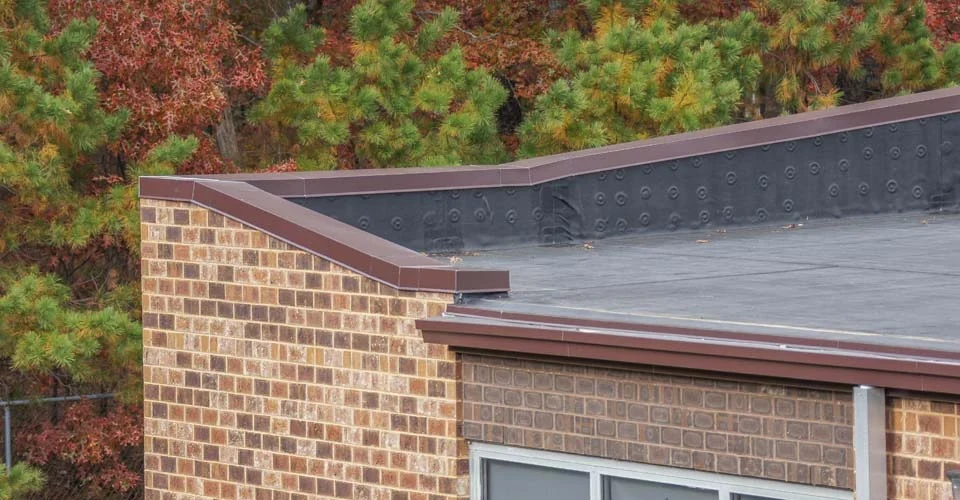
Scuppers carry water through a parapet wall rather than down through the roof deck, and they're common on the parapet-wall commercial buildings found through Old Town, Midtown, and a lot of the newer retail construction along the Harmony Corridor. A scupper that's undersized for the roof area it drains, or one that's partially blocked by debris, backs water up against the parapet and creates ponding right where the membrane meets the wall — one of the worst places on a roof for standing water to sit.
We size scuppers to the actual drainage area rather than to whatever opening already exists in the parapet, and we install overflow scuppers set slightly higher than primary scuppers as a backup when a primary drain or scupper clogs during a heavy storm. That overflow detail is inexpensive relative to the water damage it prevents when a primary drain fails during a fast-moving hail event.
Ponding Water and What Causes It
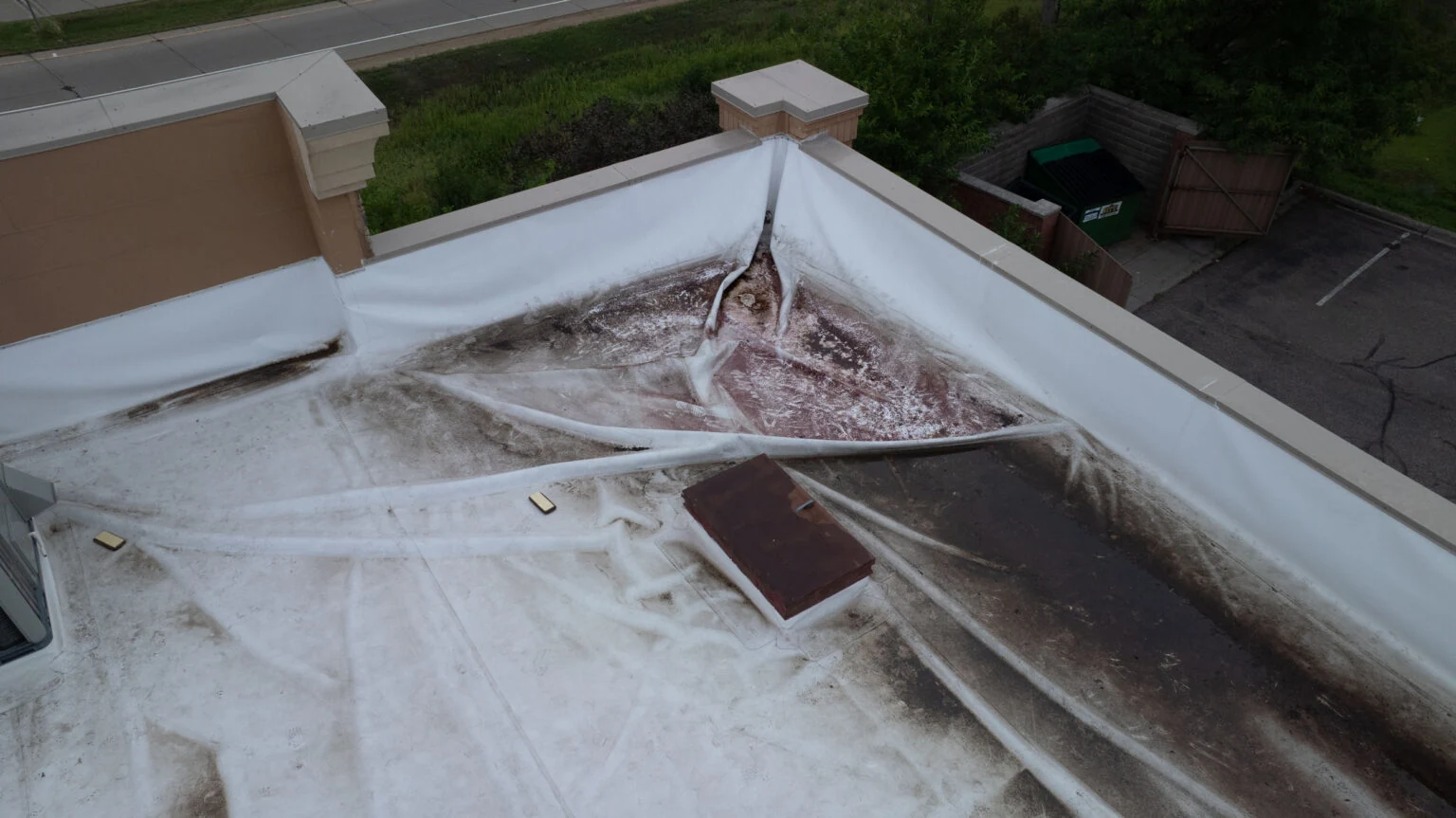
Standing water that doesn't clear within 48 hours after a rain accelerates membrane aging, promotes algae and debris buildup, and adds dead load to the roof structure. Most ponding on Fort Collins roofs traces back to one of a few causes: a low spot in the original deck construction, insufficient slope built into a recover or reroof, a clogged or failing drain, or settlement over time. We identify which of these is actually happening rather than just treating the symptom.
Sometimes the fix is drain service. Sometimes it's tapered insulation added during a reroof to correct slope permanently. We don't push a bigger tapered-insulation job on a roof that just needs its drains cleared and serviced — we diagnose first and recommend based on what's actually causing the water to sit.
Seasonal Debris and Hail Granule Loading
Fort Collins sees real seasonal debris load — cottonwood seed and leaf litter in fall, and after any hail event, a surge of granules washed off the membrane surface that heads straight for the nearest drain or scupper. A drain that handled water fine in June can be substantially restricted by August if it hasn't been checked since spring. We recommend drain and scupper clearing as part of a seasonal maintenance rhythm, particularly after storm season, and we tie that into our preventive maintenance program for buildings that want it handled on a schedule rather than reactively.
- Strainer clearing and clamping ring inspection on internal drains
- Sump slope verification to confirm water actually reaches the drain
- Scupper sizing checked against actual roof drainage area
- Overflow scupper installation as backup protection
- Ponding source diagnosis — deck, slope, or drain failure
- Post-storm granule and debris clearing at all drainage points
Why Drainage Gets Overlooked
Drains and scuppers are easy to ignore because they're small, low on the roof, and rarely inspected on their own — most owners think about them only after water is already backing up. We check every drainage point on every roof inspection we do, whether the visit was called for drainage or for something else entirely, because a clogged drain found early is a five-minute fix and a clogged drain found during a storm is an interior water damage claim.
Drainage Questions From Fort Collins Property Owners
How often should roof drains actually be checked?
At minimum twice a year — spring and fall — plus after any significant hail or wind event, since granule and debris loading spikes after storms.
My drain strainer is clear but I still see ponding. What's going on?
That points toward either a clamping ring seal problem or a slope issue in the sump, not a clog. We check both when a clear strainer doesn't explain the ponding.
Do all commercial roofs need overflow scuppers?
Not all, but it's a low-cost safeguard on any roof where a single primary drain or scupper failing could mean significant water backup, which describes most flat commercial roofs here.
Can ponding water actually damage a roof, or is it just cosmetic?
It's functional, not cosmetic. Standing water accelerates membrane breakdown, adds structural load, and often signals a slope or drainage problem that gets worse if left alone.
Do you handle drain and scupper repairs on roofs you didn't originally install?
Yes. Drainage repair and service isn't tied to who installed the roof — we work on existing systems regardless of the original installer.
Roof
GALLERY